Hopper Throttle® MaxStax™ Soybean advanced planter box treatment copack on naked soybeans topped liquid seed treatment in the 2025 Soybean Systems Management Trial conducted by the University of Illinois Urbana-Champaign.
“The bottom line is, MaxStax can replace and outperform liquid seed treatment,” said Mitch Eviston, Meristem founder and CEO. “The results from this third-party university research add another layer of confidence for our patented Bio-Capsule Technology™ and our in-season product portfolio. The findings we saw from U of I this year also really demonstrate the value of using the whole Meristem program from start to finish. The insights we can gain from this type of research will help Meristem continue to innovate moving forward.”
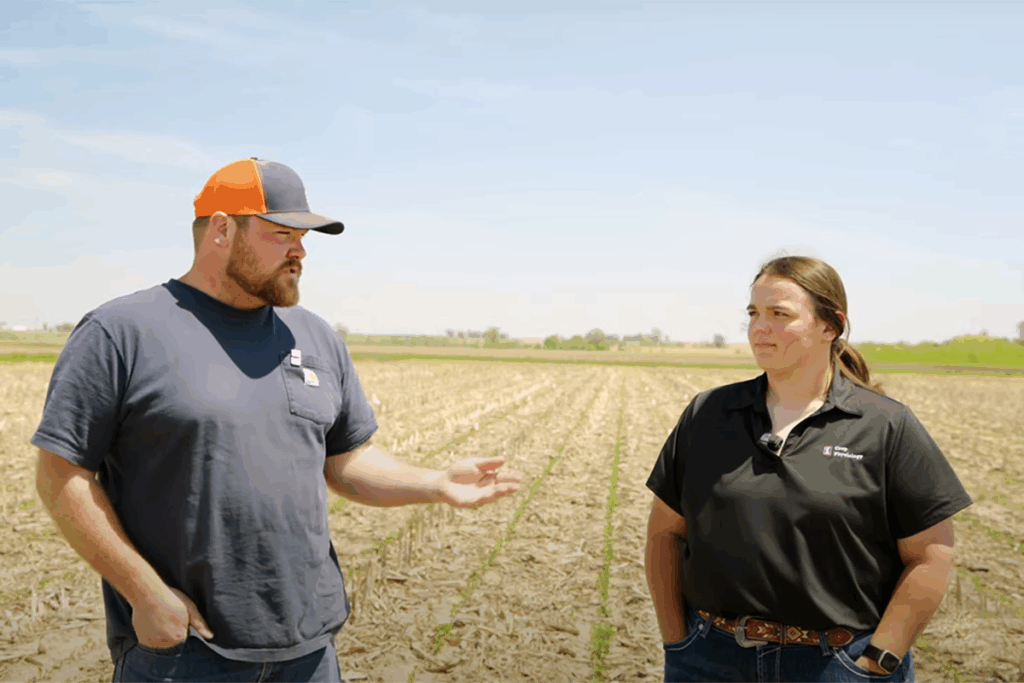
Soybean Systems Management Trial: Champaign, Ill.
For this trial conducted by the team at the U of I Department of Crop Sciences Crop Physiology Lab, no-till soybeans were planted into corn stalks April 18. The research compared 12 combinations of different seed treatments and foliar applications replicated 5 times in randomized block design. Grain yield and quality from the different treatments were evaluated.
Ava Isaacs, U of I graduate research assistant in the Department of Crop Sciences, managed the trials with research professor Dr. Connor Sible and professor Dr. Fred Below. Dry conditions late in the season limited yields at the Champaign site, but across the treatments, MaxStax on naked soybeans rose to the top.
“Averaged across foliar sprays, MaxStax had an advantage over commercial seed treatment by 2.3 bushels per acre and we saw the greatest responses with MaxStax when followed by a foliar application,” Sible said.
U of I Planting Date Trial: Champaign, Ill.
In a separate Planting Date Trial, no-till soybeans were planted into standing corn stalks at a rate of 140,000 seeds per acre in 30-inch rows on two dates: April 15 and May 19. Across those two planting dates, U of I researchers compared different combinations of Meristem products with a control treatment and standard commercial fungicide/insecticide seed treatment.
- Residue Management: Prior to planting, Excavator® AMS with Cyclestrike™ LR was applied to break down corn residue and release nutrients, compared with no residue management application prior to planting.
- Seed Treatment: At planting, the research compared soybeans with no seed treatment, traditional commercial seed treatment, and MaxStax Soybean.
- V4 Foliar: At V4, Harvestshield™ Complete was applied as a foliar stimulant, compared to no V4 application.
- All treatments received R3 fungicide application and insecticide application.
April 15 planting date results (excerpt from U of I 2025 Planting Date Trial)
| Residue Management | Seed Treatment | V4 Foliar | Yield (bu./ac.) |
| None | None | None | 63.3 |
| None | Commercial | None | 63.5 |
| None | MaxStax | None | 64.9 |
| Excavator AMS | Commercial | Harvestshield | 66.3 |
| Excavator AMS | MaxStax | Harvestshield | 67.2* |
*High yield for all trial treatments
“The treatment resulting in the highest yield for the early planted soybeans was the full Meristem program with 67.2 bushels — a 3.9-bushel yield advantage over the control,” Isaacs said.
Across the treatments, early planted soybeans yielded higher than late planted soybeans with a 9-bushel-per-acre increase. For the late planted soybeans, the treatment resulting in the highest yield was Excavator AMS with Cyclestrike and MaxStax on naked seed with 59 bushels per acre — a 4.6-bushel yield advantage over the control.
“That yield increase is a big change,” Below said. “If we even see a bushel and a half it is a pretty nice yield increase when it comes to biological products.”
Back to Newsroom